Based on data from the Bureau of Labor Statistics, the Department of Education, and independent studies, the Department of Health and Human Services (HHS) estimates a shortfall of approximately 51,000 qualified health IT workers over the next five years. To that end, on Friday, April 2, 2010, the (HHS) announced awards totaling $84 million to 16 universities and junior colleges to help support the training and development of more than 50,000 new health IT professionals. Read the link below
Educational Funding for 12 Key Healthcare IT Workforce Roles On the Way!
Showing posts with label Health. Show all posts
Showing posts with label Health. Show all posts
Saturday, December 4, 2010

Monday, November 29, 2010
Home Health Services -mHealth
Organized home health in India is an untapped potential. Home health care is defined as rendering predominantly medically-related services to patients in a home setting rather than in a medical facility. Home health care may include skilled nursing in addition to speech, occupational and physical therapy. It also includes monitoring the patient's prescriptions. In an Indian context, assistance to activities of daily living does not seem to make much sense.
What are the challenges in putting together a home health delivery model?
-> Organizing a fleet of nurses and therapists (Logistics)
-> Maintaining longitudinal patient progress and history
-> Minimize manual documentation requirements
-> Lack of ability to compare the acquired data with reference values
-> Open source software to capture data at patient site
-> Sync up PC data to the Hospital Information System or EMR
-> Connectivity to the Internet at the patient premises for self monitoring
-> Medical device to PC or cellular connection using USB, wire or Bluetooth
-> Data transmission via broadband, GSM, CDMA to Hospital Information System
Some considerations:
(1) Use of wireless Body Area Networks (BAN) as an alternative to conventional monitor - Example: The disposable unit consists of a ECG patch, analog amplification circuit, battery, and radio transmitter that sends signals to a Wireless Handheld Device either through USB or Bluetooth. The handheld will connect to the Mobile Healthcare Platform of the Hospital Information System.
(2) Use of tele-health monitors that capture data from multiple devices and transmit data to back-end servers via broadband.
With advent of 3G networks and low cost broadband services and WiFi, connectivity to the back end servers will be easier than before.
(3) Evaluation of Free Open Source Software (FOSS) for mobile platform and its counterpart back end enterprise application is a challenge.
Based on survey conducted by Center for Social Research India for Novo Nordisk in 2006 for diabetes monitoring, Home based monitoring was 86% less than monitoring at hospital and 89% of the patients are self funded. For a sustainable model for the service provider, more number of people need to adopt home monitoring. Longitudinal information capture and automatic alerting, self reliance, logistical ease are good value proposals for patients to switch.
What are the challenges in putting together a home health delivery model?
-> Organizing a fleet of nurses and therapists (Logistics)
-> Maintaining longitudinal patient progress and history
-> Minimize manual documentation requirements
-> Lack of ability to compare the acquired data with reference values
-> Open source software to capture data at patient site
-> Sync up PC data to the Hospital Information System or EMR
-> Connectivity to the Internet at the patient premises for self monitoring
-> Medical device to PC or cellular connection using USB, wire or Bluetooth
-> Data transmission via broadband, GSM, CDMA to Hospital Information System
Some considerations:
(1) Use of wireless Body Area Networks (BAN) as an alternative to conventional monitor - Example: The disposable unit consists of a ECG patch, analog amplification circuit, battery, and radio transmitter that sends signals to a Wireless Handheld Device either through USB or Bluetooth. The handheld will connect to the Mobile Healthcare Platform of the Hospital Information System.
(2) Use of tele-health monitors that capture data from multiple devices and transmit data to back-end servers via broadband.
With advent of 3G networks and low cost broadband services and WiFi, connectivity to the back end servers will be easier than before.
(3) Evaluation of Free Open Source Software (FOSS) for mobile platform and its counterpart back end enterprise application is a challenge.
Based on survey conducted by Center for Social Research India for Novo Nordisk in 2006 for diabetes monitoring, Home based monitoring was 86% less than monitoring at hospital and 89% of the patients are self funded. For a sustainable model for the service provider, more number of people need to adopt home monitoring. Longitudinal information capture and automatic alerting, self reliance, logistical ease are good value proposals for patients to switch.
Concept to Reality – Home Health Services
A preamble to introducing a new service or product is the associated marketing plan also known as the business development plan. Successfully introducing organized home health in the market involves painstaking research to understand the segment that will be receptive to the offer, the target population that will consume the service, and the positioning of the service. The positioning must consider internal imperatives and external competitive forces and cover strategic and tactical dimensions. This note presents initial thoughts and consideration to drive the first steps of the initiative.
Some critical questions that the plan should address are as follows:
• Definition of home health
• Demographic analysis of the market
• Manpower requirements and logistics
• Competitive climate
• Use of technology in health monitoring
• Financial analysis and breakeven
• Infrastructure requirements
• Roadmap and milestones
• Key differentiators (business model)
• Early internal alignment
Few challenges:
• Most reports on Indian Hospital sector are expensive
• The requirements vary dramatically from urban to rural and among age groups
• No canned reports on home health
• Need to understand regulatory and liability constraints
• Need to work with technology vendors to demonstrate a workable prototype as a part of the study
A suggested approach to convert the concept to a tangible plan is to put together a funded task force. The funded team should consist of two sets of individuals. One group will work with the internal verticals to assess the viability of services offered under the proposed umbrella. The other team should focus on the market dynamics culling primary and secondary market intelligence data. The team should be very familiar with the corporate vision, operational expectations, and financials.
Some critical questions that the plan should address are as follows:
• Definition of home health
• Demographic analysis of the market
• Manpower requirements and logistics
• Competitive climate
• Use of technology in health monitoring
• Financial analysis and breakeven
• Infrastructure requirements
• Roadmap and milestones
• Key differentiators (business model)
• Early internal alignment
Few challenges:
• Most reports on Indian Hospital sector are expensive
• The requirements vary dramatically from urban to rural and among age groups
• No canned reports on home health
• Need to understand regulatory and liability constraints
• Need to work with technology vendors to demonstrate a workable prototype as a part of the study
A suggested approach to convert the concept to a tangible plan is to put together a funded task force. The funded team should consist of two sets of individuals. One group will work with the internal verticals to assess the viability of services offered under the proposed umbrella. The other team should focus on the market dynamics culling primary and secondary market intelligence data. The team should be very familiar with the corporate vision, operational expectations, and financials.
Weaving IT into Organizational Strategy
Information technology has progressively moved from the periphery to the center of corporate strategy. This brief is not a prescription or an exhaustive recommendation but only brings to fore some of points to trigger in depth analysis on IT-Business alignment.
To build an effective foundation for execution, an organization has to pay attention to its operating model, enterprise architecture, and IT engagement model. Such a foundation calls for formulating an IT strategy that aligns with the business strategy, building internal partnerships between IT and business units, and reengineering of IT as a business partner. IT must enable, support, and drive organization growth. Creating or changing the information strategy impacts corporate strategic planning process, organizational structure and power equations, information systems responsibilities, and technology stack.
The first step to having an empowering IT agenda is to recognize the associated cost implications, complexity, and consequences. “Defensive IT” ensures operational reliability while “Offensive IT” helps organizations leapfrog the competition through clever use of emerging technologies and carries an element of risk. Each style has unique governance needs and must be lead by a skilled communicator who can challenge entrenched in-house thinking. An important point to keep in mind is that achieving and sustaining IT-business alignment is difficult and often treacherous.
Health sector in general has been lagging in adopting information technology for a variety of reasons like lack of demonstrated cost effectiveness, interoperability, high adoptions cost, and confidentiality requirements. Some of the challenges are unique to the health industry alone but many are common to industries at large and it may be worthwhile taking lessons from outside of this vertical.
Bringing information strategy into the boardroom makes the organization agile and equips it to respond quickly to a fast changing and evolving market. It brings together motivated experts, empowered decision makers and digitized process. A strategic execution officer or the CIO, under the umbrella of a “Center of Excellence for Innovation and Technology,” could evangelize the need for strategic information management, make IT investment decisions, transition management, and coordinate enterprise change projects.
To build an effective foundation for execution, an organization has to pay attention to its operating model, enterprise architecture, and IT engagement model. Such a foundation calls for formulating an IT strategy that aligns with the business strategy, building internal partnerships between IT and business units, and reengineering of IT as a business partner. IT must enable, support, and drive organization growth. Creating or changing the information strategy impacts corporate strategic planning process, organizational structure and power equations, information systems responsibilities, and technology stack.
The first step to having an empowering IT agenda is to recognize the associated cost implications, complexity, and consequences. “Defensive IT” ensures operational reliability while “Offensive IT” helps organizations leapfrog the competition through clever use of emerging technologies and carries an element of risk. Each style has unique governance needs and must be lead by a skilled communicator who can challenge entrenched in-house thinking. An important point to keep in mind is that achieving and sustaining IT-business alignment is difficult and often treacherous.
Health sector in general has been lagging in adopting information technology for a variety of reasons like lack of demonstrated cost effectiveness, interoperability, high adoptions cost, and confidentiality requirements. Some of the challenges are unique to the health industry alone but many are common to industries at large and it may be worthwhile taking lessons from outside of this vertical.
Bringing information strategy into the boardroom makes the organization agile and equips it to respond quickly to a fast changing and evolving market. It brings together motivated experts, empowered decision makers and digitized process. A strategic execution officer or the CIO, under the umbrella of a “Center of Excellence for Innovation and Technology,” could evangelize the need for strategic information management, make IT investment decisions, transition management, and coordinate enterprise change projects.
Thursday, November 25, 2010
Healthcare IT in India - An Optimistic Outlook - Issue 18 - Information Technology - Asian Hospital & Healthcare Management
Challenges in integrating IT into the healthcare system in India are many, but they can be addressed through leadership and vision.
Healthcare IT in India - An Optimistic Outlook - Issue 18 - Information Technology - Asian Hospital & Healthcare Management
Healthcare IT in India - An Optimistic Outlook - Issue 18 - Information Technology - Asian Hospital & Healthcare Management
Revamped Info System revives Delhi Hospital
Sir Ganga Ram Hospital in Delhi has gone on a journey of computerisation for more than two decades. An in-house system was built in the beginning. But it became “terribly dated”, prompting the hospital to adopt a commercially available package Health Information System
Read the full article here on Future Gov India
Read the full article here on Future Gov India
Sunday, November 21, 2010
Healthcare Technology Investments in India
Read this interesting article by following the link below
Kid in a Candy Store
A Springboard press release on Healthcare IT Spending in India
Healthcare IT Spending in India to Grow at 22% from 2009-13, finds Springboard Research
Kid in a Candy Store
A Springboard press release on Healthcare IT Spending in India
Healthcare IT Spending in India to Grow at 22% from 2009-13, finds Springboard Research
Public market research reports for Healthcare Market Research in India
There are some reports available in the public domain (Members only access though :-( ). Links to premium reports are also given in the website. Please follow the link below.
Public market research reports for Healthcare Market Research in India, November 2010
Public market research reports for Healthcare Market Research in India, November 2010
Monday, November 8, 2010
Innovations in Healthcare Management and Innovations
IPQC has some great papers and presentations on the following:
Mobile Healthcare Delivery
e-Health in Asia Pacific
Defining and Testing EMR Usability
Click here to read them. All free IPQC Konwledge Center
Enjoy the read
Mobile Healthcare Delivery
e-Health in Asia Pacific
Defining and Testing EMR Usability
Click here to read them. All free IPQC Konwledge Center
Enjoy the read
Friday, September 24, 2010
PWC report on Healthcare in India
PWC report on Healthcare in India
Healthcare is one of India’s largest sectors, in terms of revenue and
employment, and the sector is expanding rapidly. During the 1990s, Indian
healthcare grew at a compound annual rate of 16%. Today the total value
of the sector is more than $34 billion. This translates to $34 per capita,
or roughly 6% of GDP. By 2012, India’s healthcare sector is projected to
grow to nearly $40 billion.
The private sector accounts for more than 80% of total healthcare
spending in India. Unless there is a decline in the combined federal and
state government deficit, which currently stands at roughly 9%, the
opportunity for significantly higher public health spending will be limited
Healthcare is one of India’s largest sectors, in terms of revenue and
employment, and the sector is expanding rapidly. During the 1990s, Indian
healthcare grew at a compound annual rate of 16%. Today the total value
of the sector is more than $34 billion. This translates to $34 per capita,
or roughly 6% of GDP. By 2012, India’s healthcare sector is projected to
grow to nearly $40 billion.
The private sector accounts for more than 80% of total healthcare
spending in India. Unless there is a decline in the combined federal and
state government deficit, which currently stands at roughly 9%, the
opportunity for significantly higher public health spending will be limited
Wednesday, July 7, 2010
Control Charts in healthcare
Control Charts in healthcare
Statistical Process Control is a methodology of statistical analysis used to discover special cause variation in a process. In healthcare, it is used to document that a critical process is in control and alert responsible parties should there be a deviation. A typical control chart is a graphical representation of the quality indicator, as either individual values or calculated subgroups with the data displayed sequentially and time ordered [Refer to illustration 1 in Appendix]. Horizontal lines represent the central tendency (mean), upper and lower control limits typically set at +3 standard deviations from the mean [1]. In this paper, we will list down the types of control charts available and guidelines to interpret it.
Types of Control Charts
In 1920s by Walter Shewhart developed it to improve industrial manufacturing. It first migrated to healthcare in laboratory settings and then into direct patient care applications [2].
There are four commonly used control charts [Refer to illustration 2, 3 in Appendix]. Control are categorized as upper (+) and lower (-).

A process is “in control” when it has the following characteristics [3]:
No points are outside the control limits – the traditional and most popular SPC chart guideline,
The number of points above and below the center line is about the same,
The points seem to fall randomly above and below the center line,
Most points, but not all, are near the centerline, and only a few are close to the control limits.
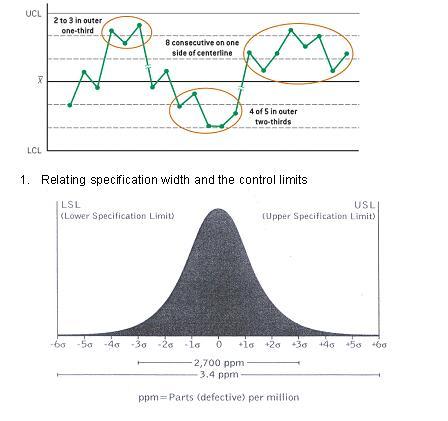
Evaluating the “patterns in the sample data” using guidelines such as [Refer to illustration 4 in Appendix]:
Eight points in a row above or below the center line
10 of 11 consecutive points above or below the center line
12 of 14 consecutive points above or below the center line
Two of three consecutive points in the outer one-third region between the center line and one of the control limits
Four of five consecutive points in the outer two-thirds region between the centerline and one of the control limits.
Basic Guidelines
In general, in applying statistical process control, we need to delineate the following:
The study and design objectives
Study settings - entire hospital, department etc
Fields of healthcare – anesthesia, pathology etc
Unit of analysis – Clinicians, patient, staff etc
Variables – Oxygen saturation, time to complete etc
Benefits – Impact assessment, quantify process variability etc
However, a number of special issues arise in health care applications of SPC. One of these is the question of what to measure. In health care applications, there is concern and debate about excessive emphasis on outcome metrics and report cards to the detriment of process understanding and improvement. Another issue is the problem of how to aggregate, adjust, and present rate data, used to make decisions [5].
Conclusion
Control charts provide an effective method to visualize data over a specific monitoring period while considering for boundary conditions. Usually the control limits are well within the specification limits for a capable process [Refer to illustration 5 in Appendix]. Continuing use of the control chart helps to check if the corrective action has resulted in an improved process. They allow hospital administrators to have a more engaging conversation with the physicians in the wake of the collected data. When shared between providers, control charts they drive higher standards of care. Patient identification and non-infectious hazards of transfusion are some typical bio-vigilance areas where software process control finds effective application.


References
[1] Continuous quality improvement of perfusion practice. The role of electronic data collection and statistical control chart. RA Baker, RF Newland. Perfusion 2008 23:7-16
[2] Application of statistical process control in healthcare improvement: systematic review. Johan Thor, Jonas Lundberg, Jakob Ask, Jesper Olsson, Cheryl Carli, Karin Pukk Ha¨renstam, Mats Brommels. Qual Saf Health Care 2007;16:387–399. doi: 10.1136/qshc.2006.022194
[3] Operations Management, D.A. Collier, J.R. Evans(2007)
[4] Errors in patient specimen collection: application of statistical process control. Walter Sunny Dzik, Neil Beckman, Kathleen Selleng, Nancy Heddle, Zbigniew Szczepiorkowski, Silvano Wendel, and Michael Murphy for the Biomedical Excellence for Safer Transfusion (BEST) Collaborative (2008)
[5] Health Care Applications of Statistical Process Control: Examples Using the SASâ System Robert N. Rodriguez SAS Institute Inc. Cary, North Carolina, USA
Statistical Process Control is a methodology of statistical analysis used to discover special cause variation in a process. In healthcare, it is used to document that a critical process is in control and alert responsible parties should there be a deviation. A typical control chart is a graphical representation of the quality indicator, as either individual values or calculated subgroups with the data displayed sequentially and time ordered [Refer to illustration 1 in Appendix]. Horizontal lines represent the central tendency (mean), upper and lower control limits typically set at +3 standard deviations from the mean [1]. In this paper, we will list down the types of control charts available and guidelines to interpret it.
Types of Control Charts
In 1920s by Walter Shewhart developed it to improve industrial manufacturing. It first migrated to healthcare in laboratory settings and then into direct patient care applications [2].
There are four commonly used control charts [Refer to illustration 2, 3 in Appendix]. Control are categorized as upper (+) and lower (-).

A process is “in control” when it has the following characteristics [3]:
No points are outside the control limits – the traditional and most popular SPC chart guideline,
The number of points above and below the center line is about the same,
The points seem to fall randomly above and below the center line,
Most points, but not all, are near the centerline, and only a few are close to the control limits.
Evaluating the “patterns in the sample data” using guidelines such as [Refer to illustration 4 in Appendix]:
Eight points in a row above or below the center line
10 of 11 consecutive points above or below the center line
12 of 14 consecutive points above or below the center line
Two of three consecutive points in the outer one-third region between the center line and one of the control limits
Four of five consecutive points in the outer two-thirds region between the centerline and one of the control limits.
Basic Guidelines
In general, in applying statistical process control, we need to delineate the following:
The study and design objectives
Study settings - entire hospital, department etc
Fields of healthcare – anesthesia, pathology etc
Unit of analysis – Clinicians, patient, staff etc
Variables – Oxygen saturation, time to complete etc
Benefits – Impact assessment, quantify process variability etc
However, a number of special issues arise in health care applications of SPC. One of these is the question of what to measure. In health care applications, there is concern and debate about excessive emphasis on outcome metrics and report cards to the detriment of process understanding and improvement. Another issue is the problem of how to aggregate, adjust, and present rate data, used to make decisions [5].
Conclusion
Control charts provide an effective method to visualize data over a specific monitoring period while considering for boundary conditions. Usually the control limits are well within the specification limits for a capable process [Refer to illustration 5 in Appendix]. Continuing use of the control chart helps to check if the corrective action has resulted in an improved process. They allow hospital administrators to have a more engaging conversation with the physicians in the wake of the collected data. When shared between providers, control charts they drive higher standards of care. Patient identification and non-infectious hazards of transfusion are some typical bio-vigilance areas where software process control finds effective application.

References
[1] Continuous quality improvement of perfusion practice. The role of electronic data collection and statistical control chart. RA Baker, RF Newland. Perfusion 2008 23:7-16
[2] Application of statistical process control in healthcare improvement: systematic review. Johan Thor, Jonas Lundberg, Jakob Ask, Jesper Olsson, Cheryl Carli, Karin Pukk Ha¨renstam, Mats Brommels. Qual Saf Health Care 2007;16:387–399. doi: 10.1136/qshc.2006.022194
[3] Operations Management, D.A. Collier, J.R. Evans(2007)
[4] Errors in patient specimen collection: application of statistical process control. Walter Sunny Dzik, Neil Beckman, Kathleen Selleng, Nancy Heddle, Zbigniew Szczepiorkowski, Silvano Wendel, and Michael Murphy for the Biomedical Excellence for Safer Transfusion (BEST) Collaborative (2008)
[5] Health Care Applications of Statistical Process Control: Examples Using the SASâ System Robert N. Rodriguez SAS Institute Inc. Cary, North Carolina, USA
Monday, February 8, 2010
Revenue Cycle Management in Healthcare organization
Revenue cycle management is one of the most complex operations in the healthcare settings. Below is a diagram to illustrate the same. My thanks to my friend and classmate Clay Demler for giving me a flow chart.


Tuesday, January 19, 2010
Short Primer on HIT data
As i trudge along unlearning and relearning fundamentals in my class, i thought it might be a good idea to pen down some of it.
Some key terminologies
Data: Empirical observations, symbols, numbers. They simply exist with no structure. A "know nothing" stage
Information: Data organized with relationships. No necessarily useful but is the building block for eveything else.. A "know what" stage
Knowledge: Information that has a pattern and is useful. Enables decision making. A "know how" stage
Understanding: Allows use of the known based on principles and fosters new knowledge. A "know why" stage
The types of information in a typical healthcare setting are as follows:
Internal , External and Comparative
Internal information may relate to
Patient encounter (patient-specific or aggregate) & (clinical or administrative)
General Operations
Exernal information is knowledge based
Comparative information - Outcome measure (over a period of time or against standard)
Common categories of benchmarking are patient satisfaction, practice patterns, health plans, clinical indicators, population measures.
A few key standards to note
ICD-9-CM is also known as international classification of disease Clinical modification. It is used to determine diagnostic related group. Critical to accurate institutional reimbursement
CPT - Current procedural terminology. It is used to provide information on medical and surgical services.
CMS 1450 and CMS 1500 are 2 common billing standards
A health executive needs to be sure of the source of the information, its accuracy and semantics. Given multiple standards agencies and multiple forces acting upon the healthcare organization, it is important to have a common understanding of the terms. A good reference is the document embedded below. It is taken as from the hhs.gov website as a reference.
Some key takeaways from a definition standpoint are given below:
EMR - Electronic medical record - Maintain within organization boundaries and owned by the provider
EHR - Interoperable data maintained to be shared across organizations in conformance with national standards
PHR - Personal heatlh record - Individually owned and maintained
Health Information Exchange is the entity that will facilitate the EHR exchange nationally. They will work with Regional Extension Centers (Health Information Organization). HIOs will collaborate with Regional Health Information Organization which are collaborated network between providers in a specific geography.
Some key terminologies
Data: Empirical observations, symbols, numbers. They simply exist with no structure. A "know nothing" stage
Information: Data organized with relationships. No necessarily useful but is the building block for eveything else.. A "know what" stage
Knowledge: Information that has a pattern and is useful. Enables decision making. A "know how" stage
Understanding: Allows use of the known based on principles and fosters new knowledge. A "know why" stage
The types of information in a typical healthcare setting are as follows:
Internal , External and Comparative
Internal information may relate to
Patient encounter (patient-specific or aggregate) & (clinical or administrative)
General Operations
Exernal information is knowledge based
Comparative information - Outcome measure (over a period of time or against standard)
Common categories of benchmarking are patient satisfaction, practice patterns, health plans, clinical indicators, population measures.
A few key standards to note
ICD-9-CM is also known as international classification of disease Clinical modification. It is used to determine diagnostic related group. Critical to accurate institutional reimbursement
CPT - Current procedural terminology. It is used to provide information on medical and surgical services.
CMS 1450 and CMS 1500 are 2 common billing standards
A health executive needs to be sure of the source of the information, its accuracy and semantics. Given multiple standards agencies and multiple forces acting upon the healthcare organization, it is important to have a common understanding of the terms. A good reference is the document embedded below. It is taken as from the hhs.gov website as a reference.
Some key takeaways from a definition standpoint are given below:
EMR - Electronic medical record - Maintain within organization boundaries and owned by the provider
EHR - Interoperable data maintained to be shared across organizations in conformance with national standards
PHR - Personal heatlh record - Individually owned and maintained
Health Information Exchange is the entity that will facilitate the EHR exchange nationally. They will work with Regional Extension Centers (Health Information Organization). HIOs will collaborate with Regional Health Information Organization which are collaborated network between providers in a specific geography.
Subscribe to:
Posts (Atom)